


/file/publisher-c1a3f893382d2b2f8a9aa22a654d9c97/2022/08/83e4a518b493d3fb95ccd5f96db39668.jpg)

PAS-BN electoral play in 23 seats faces Bersatu wildcard
At first glance, this appears advantageous to BN. However, PN's votes may not necessarily transfer entirely to BN. The crucial detail is that PN’s support base in Johor is primarily anchored by Bersatu, not PAS.
Following the bitter split between PAS and Bersatu, PAS can discipline its own members and supporters, but Bersatu’s rank-and-file are highly unlikely to dance to PAS’ tune, and their votes will decide the outcome of these 23 seats.
If PAS members and supporters strictly adhere to their leadership's directives, this bloc of Malay votes could indeed shift to BN. In highly competitive mixed-demographic constituencies, the movement of just...
JOHOR POLLS | Perikatan Nasional is contesting only 33 seats in this Johor election, and PAS has called on its members and supporters to cast their votes for BN in the 23 seats where PN is sitting out.
At first glance, this appears advantageous to BN. However, PN's votes may not necessarily transfer entirely to BN. The crucial detail is that PN’s support base in Johor is primarily anchored by Bersatu, not PAS.
Following the bitter split between PAS and Bersatu, PAS can discipline its own members and supporters, but Bersatu’s rank-and-file are highly unlikely to dance to PAS’ tune, and their votes will decide the outcome of these 23 seats.
If PAS members and supporters strictly adhere to their leadership's directives, this bloc of Malay votes could indeed shift to BN. In highly competitive mixed-demographic constituencies, the movement of just a few thousand Malay votes is enough to tip the scales.
However, PN in Johor is vastly different from PN in the northern states. In states like Kelantan, Terengganu, Kedah, and even Perlis or Penang, the coalition’s grassroots strength is almost entirely driven by PAS. In other words, the PN vote and PAS vote overlap.
Bersatu’s pull in Johor
Johor is a different story. The coalition relies more on Bersatu’s local machinery, former Umno grassroots networks, the personal influence of Bersatu president Muhyiddin Yassin, and a significant bloc of Malay voters who are disgruntled with Umno.
Election data and statistics bear this out. In this state election, the 23 seats PN opted out of are:
Buloh Kasap, Parit Yaani, Machap, Tanjung Surat, Larkin, Kempas, Benut, Pulai Sebatang, Kukup, Mahkota, Bekok, Yong Peng, Pekan Nanas, Tangkak, Bentayan, Penggaram, Mengkibol, Perling, Skudai, Bukit Batu, Senai, Johor Jaya, and Puteri Wangsa.
In the previous state election in March 2022, PAS contested four of these seats - Parit Yaani, Machap, Tanjung Surat, and Pulai Sebatang - but the party holds no lingering attachment to them. Of the remaining seats, Bersatu contested 12, and Gerakan seven.

While PAS secured over 20 percent of the votes in the four seats it contested, a look back at the 2018 state election results shows a different story: PAS managed vote shares of just 12.9 percent in Parit Yaani, 8.2 percent in Machap, and 10.4 percent in Pulai Sebatang. PAS did not even contest Tanjung Surat in 2018.
In Machap, Bersatu, which was still part of Pakatan Harapan at the time, clinched 44.9 percent (8,971 votes), losing by a razor-thin margin of just 404 votes to Umno's 46.9 percent.
Had PAS not siphoned off that 8.2 percent (1,630 votes), Bersatu could have captured this traditional Umno stronghold.
Among the 12 seats Bersatu opted out of in this state election, most also garnered over 20 percent of the vote in 2022, with Benut yielding their strongest showing at 29.2 percent (5,037 votes).
It is worth noting that among these 12 seats, six were contested by Bersatu’s Chinese candidates at the time, most of whom were supporters of former deputy president Hamzah Zainudin, such as Bekok candidate Tan Lek Khang.
Nevertheless, given the general voter tendency to "vote for the party, not the candidate”, Bersatu’s organisational influence in these constituencies is believed to remain far stronger than Hamzah’s personal clout.
As a splinter party of Umno and a fellow Malay nationalist party, Bersatu holds greater sway in Johor than PAS does.

Johor is not only the birthplace and cradle of Umno, but historically hosted a powerful Malay sultanate. The Malay political culture here has long been built upon the monarchy and traditional Malay nationalism.
Compared to PAS, which prioritises religious politics, Bersatu champions a nationalist line much closer to Umno’s, making it easier for them to absorb Johor's traditional Malay vote bank.
Since its inception, Bersatu has consistently maintained an adversarial relationship with Umno. Even when Muhyiddin served as prime minister from March 2020 to August 2021 and shared power with Umno in the federal government, the two parties never ceased competing.
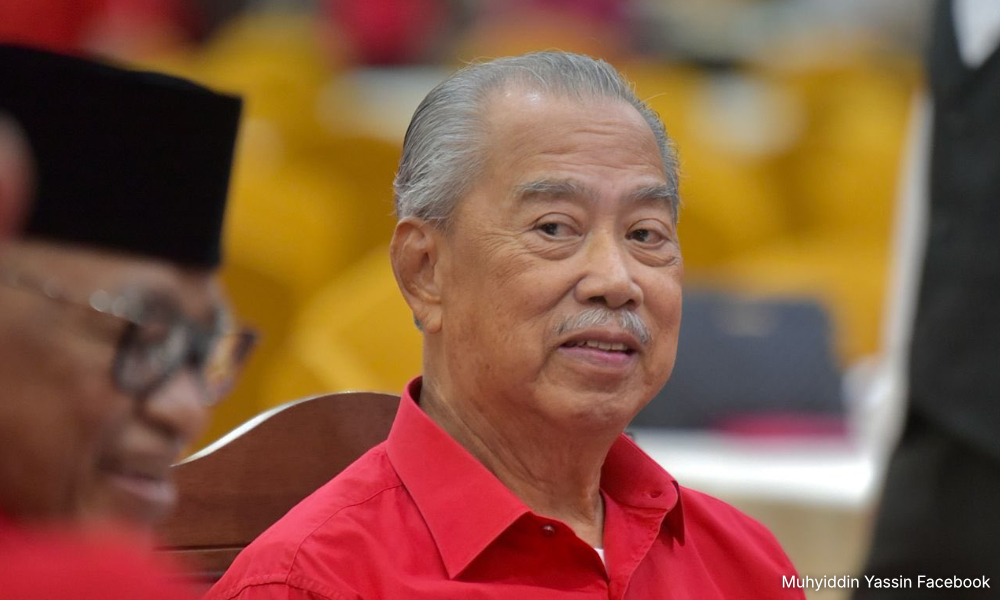
For many Bersatu members and supporters, the very reason they joined the party was their rejection, or outright disdain, of Umno’s political culture.
Consequently, even if PAS issues a clarion call "vote for BN”, it does not mean Bersatu supporters would pivot to BN.
A facade of unity
Moreover, the ties between Bersatu and PAS have already fractured.
In February this year, PAS vice-president Ahmad Samsuri Mokhtar replaced Muhyiddin as the chairperson of PN.

In June, PAS resolved to sever ties with Bersatu. Under the new leadership, PN terminated the positions of two prominent Bersatu leaders - Azmin Ali and Radzi Jidin - while welcoming Hamzah's new party, Parti Wawasan Negara, into the coalition.
As the Johor state election approached, PAS and Bersatu shelved their differences to campaign under the shared PN banner.
However, this is merely a facade of unity concealing deep-seated discord. Neither party has explicitly committed to campaigning for the other.
Confronted with PAS's unilateral overtures to BN, Bersatu leaders have distanced themselves.
Bersatu information chief Tun Faisal Ismail Aziz issued a stern statement that Bersatu's stance is to support all PN candidates, not BN.
This rift manifested clearly in Layang-Layang.
The incumbent assemblyperson, Abdul Mutalip Abd Rahim, originally from Umno, is deeply entrenched locally and has served two consecutive terms.
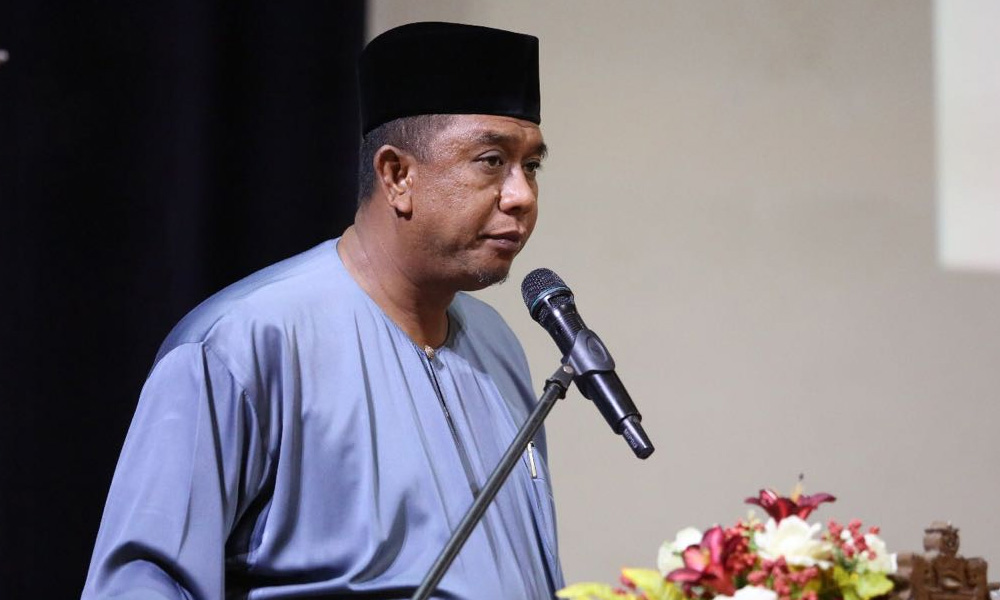
However, Umno stripped him of his right to contest in this election, handing the seat to MCA newcomer Chua Jian Boon instead.
Outraged, Mutalip quit Umno, defected to Bersatu, and entered the fray under the PN banner. But to his shock, his ally PAS embraced BN.
READ MORE: Behind the narrative: Why 25 Johor BN seats are actually at risk
This prompted a furious Mutalip to publicly call out the PAS leadership, demanding an immediate halt to statements and directives that confuse voters on the ground.
Adding fuel to the fire, two local leaders from Batu Pahat PAS division, Misran Samian and Hazrin Abd Hamid attended the launch of the BN election machinery in Rengit last Tuesday (June 30).
In Rengit, Bersatu has fielded Syed Mohamad Syed Alwi, whose opponents include Umno's Zaidi Japar.
The chaos within PN proves that assuming BN will automatically absorb all PN votes because PN is sitting out 23 seats is overly presumptuous. In these constituencies, votes previously consolidated under the PN banner are unlikely to transfer seamlessly.
Three potential paths for Bersatu voters
Bersatu members and those who previously voted for the party will likely split into three directions:
Scenario 1 is the most likely: Members loyal to Muhyiddin may choose to boycott the polls or spoil their ballots in seats where Bersatu is not contesting.
Scenario 2: A small portion of Bersatu supporters might shift their votes to BN - driven by a sense of Malay nationalism or an agreement with PAS to ensure Johor remains under a Malay-Muslim-dominated leadership - thereby helping BN further consolidate the Malay vote and giving them an upper hand across these 23 seats.
Scenario 3: A minority of younger, swing, or independent voters might reconsider supporting Harapan or vote for Parti Bersama Malaysia, the party led by Rafizi Ramli and Nik Nazmi Nik Ahmad. During the 2018 general election, Bersatu was still part of Harapan and ran under the PKR banner. However, this shift is not expected to become mainstream.
Overall, under the rules of the first-past-the-post (FPTP) electoral system, the shifts in PN's strategy still fundamentally work in favour of BN.
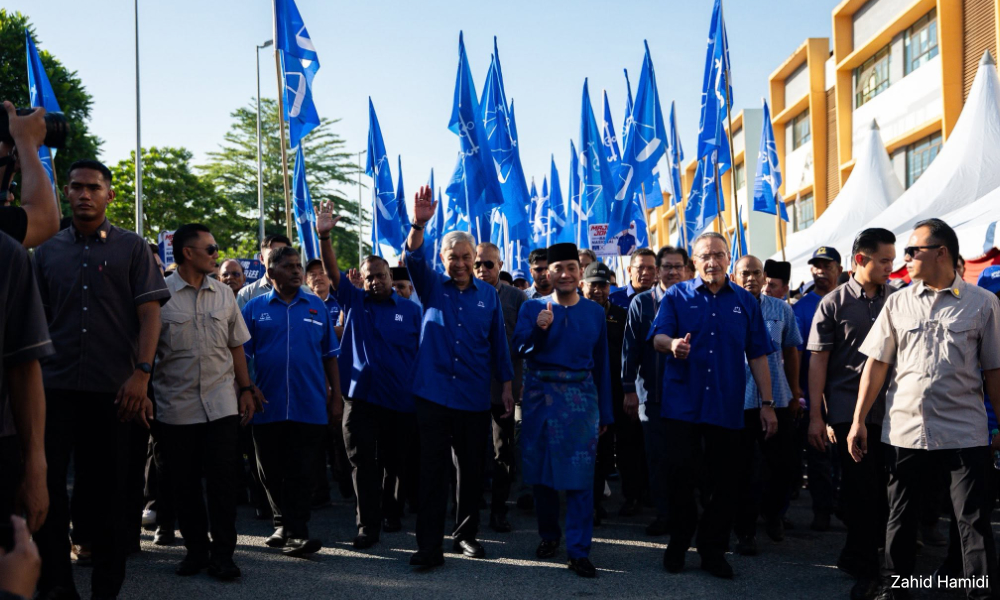
However, the more critical wildcard is how Bersatu supporters will respond. The PN support base across these 23 constituencies will be entirely redistributed.
Will these voters, who back Muhyiddin, choose to remain rigidly anti-Umno and anti-Harapan, or will they rather abstain than stand alongside their former enemies?
/file/publisher-c1a3f893382d2b2f8a9aa22a654d9c97/2026/07/c3e2e553e88fc084a521194f328fe039.jpg)
/file/publisher-c1a3f893382d2b2f8a9aa22a654d9c97/2026/06/3b673a882770ff73e6947f3be6b7223f.jpg)
/file/publisher-c1a3f893382d2b2f8a9aa22a654d9c97/2023/07/7eafbd63b2f156552c63020baea1ec13.jpg)
/file/publisher-c1a3f893382d2b2f8a9aa22a654d9c97/2024/07/fa532456c1c310bf34facb24955efc5f.jpg)
/file/publisher-c1a3f893382d2b2f8a9aa22a654d9c97/2026/06/7ed4874382b3885799795ddad174a054.jpg)
/file/publisher-c1a3f893382d2b2f8a9aa22a654d9c97/2023/07/17ec1b3915b924584dddcd03a9880c8b.jpg)


Are you sure you want to delete this comment?
This action cannot be undone.